

Why Picking the Right SIDI Isn't as Simple as "Just Buy a Boot"
Here's the problem most riders run into: they hear that SIDI makes some of the best motorcycle boots and cycling shoes in the world, they open the website, and they're immediately hit with a wall of model names, closure systems, and spec sheets. Rotor closures, Mega width, Gore-Tex liners, carbon soles — none of it means much until you know what you're actually shopping for.
That's the gap this guide is meant to close. Instead of walking through SIDI's history or its racing pedigree, this post is built around one question: based on how you actually ride, which corner of the SIDI lineup should you be looking at?
We'll break this down by rider type — street commuter, sport rider, adventure tourer, off-road/motocross rider, road cyclist, and mountain biker — and cover what to prioritize, what to skip, and how to avoid the single most common mistake U.S. buyers make when ordering SIDI gear for the first time: getting the sizing wrong.
- A rider-type breakdown instead of a general product overview
- Clear guidance on which features actually matter for your riding style
- Sizing advice specific to first-time U.S. buyers
- A straightforward way to narrow down a large product catalog fast
If You're a Daily Street Commuter
Commuters have a different set of priorities than track-day riders, and it's worth being honest about that instead of pretending everyone needs a race boot. If you're splitting lanes through city traffic, stopping and starting constantly, and walking short distances at both ends of your ride, comfort off the bike matters almost as much as protection on it.
For this rider, look toward SIDI's shorter, street-oriented boots rather than the tall, race-focused models. You want a boot with a low-profile shifter pad, a closure system you can adjust quickly with gloves on, and enough flex through the ankle that walking into a coffee shop or an office doesn't feel like wearing a cast. Waterproofing is a nice-to-have here, especially if you commute through unpredictable weather, but it's not always essential if your commute is short and you're not riding through downpours regularly.
Skip the heavily reinforced, race-replica boots for this use case — you'll be paying for protection features and stiffness you don't need for stop-and-go city riding, and you'll likely find them less comfortable to walk in throughout your day.
- Prioritize a shorter boot with flexibility for walking
- Look for quick, glove-friendly closure systems
- Waterproofing is optional unless your commute involves regular rain
- Skip heavier race boots — they're overkill for city riding
If You're a Sport or Track Day Rider
This is where SIDI's racing heritage becomes directly relevant to your buying decision. Sport and track day riders need a boot that locks the ankle down, resists twisting on impact, and gives precise feedback through the footpeg — comfort for walking around is a secondary concern compared to how the boot performs at speed and how it holds up in a get-off.
Focus on SIDI's race-line boots that feature reinforced TPU ankle protection, a rigid sole for footpeg feedback, and a rotor or multi-point closure system that lets you dial in a genuinely tight fit. Many of these boots also include replaceable toe sliders and heel cups — components worth checking for specifically, since track riders go through them faster than street riders and being able to replace just that part instead of the whole boot saves real money over a season.
Sizing note for this category specifically: because race boots are meant to fit snugly for control, it's worth trying a pair on in person if you can, or checking the brand's size chart carefully rather than assuming your usual shoe size will translate directly.
- Prioritize reinforced ankle protection and a rigid, feedback-focused sole
- Look for rotor or multi-point closures for a locked-in fit
- Check for replaceable toe sliders and heel cups
- Try before you buy when possible — race boots fit snug by design
If You're Planning a Cross-Country Adventure or Long-Distance Tour
Touring and adventure riders have arguably the toughest set of requirements to satisfy, because the boot has to do everything reasonably well over a long stretch of time — comfort for eight-hour riding days, weatherproofing for whatever the route throws at you, and enough protection to handle both highway speeds and the occasional gravel detour.
SIDI's adventure and touring boots are built specifically around this brief. Look for models with Gore-Tex waterproof/breathable liners, since staying dry on a multi-day trip is non-negotiable, along with a taller shaft for protection against debris and weather on unpaved roads. Comfort features like padded shin plates and honeycomb elastic panels around the arch area matter more here than on a track boot, since you'll be spending far more consecutive hours in them.
Also worth checking: how the boot handles both on-bike control and off-bike walking, since adventure touring often means stopping to check a map, refuel, or explore somewhere the bike can't go. A boot that's great at 70 mph but miserable to walk two blocks in isn't the right choice for this style of riding.
- Prioritize Gore-Tex waterproofing for multi-day, all-weather riding
- Look for a taller shaft for protection on mixed-surface routes
- Padded shin plates and arch support matter more for long riding days
- Balance on-bike control with off-bike walking comfort
If You Ride Off-Road or Race Motocross
Off-road and motocross riders need to think about SIDI boots differently than any other category on this list, because the failure mode you're protecting against isn't just a slide — it's a direct, high-force impact. This is the category where SIDI's racing history runs deepest, with decades of motocross world championships behind the technology in these boots.
For this riding style, prioritize boots with a full exoskeleton design, typically built from fiberglass-reinforced nylon, along with high-density resin closure systems adjustable from both sides of the boot for a secure, symmetrical fit. Anti-hyperextension systems, which limit how far the ankle can bend in a crash, are a feature worth specifically looking for if you ride aggressively or race competitively, since they're designed to reduce the severity of one of the most common off-road riding injuries.
Ventilation is another consideration many riders overlook. Off-road riding in warm-weather U.S. regions can get brutally hot inside a fully protective boot, so if you're not racing in mud and cold conditions, it's worth checking whether a given model offers a more breathable variant without sacrificing the core protective structure.
- Look for a fiberglass-reinforced nylon exoskeleton for impact protection
- Prioritize dual-side adjustable closure systems for a secure fit
- Anti-hyperextension features matter for aggressive or competitive riding
- Consider ventilation needs based on your typical riding climate
If You're a Road Cyclist Chasing Performance
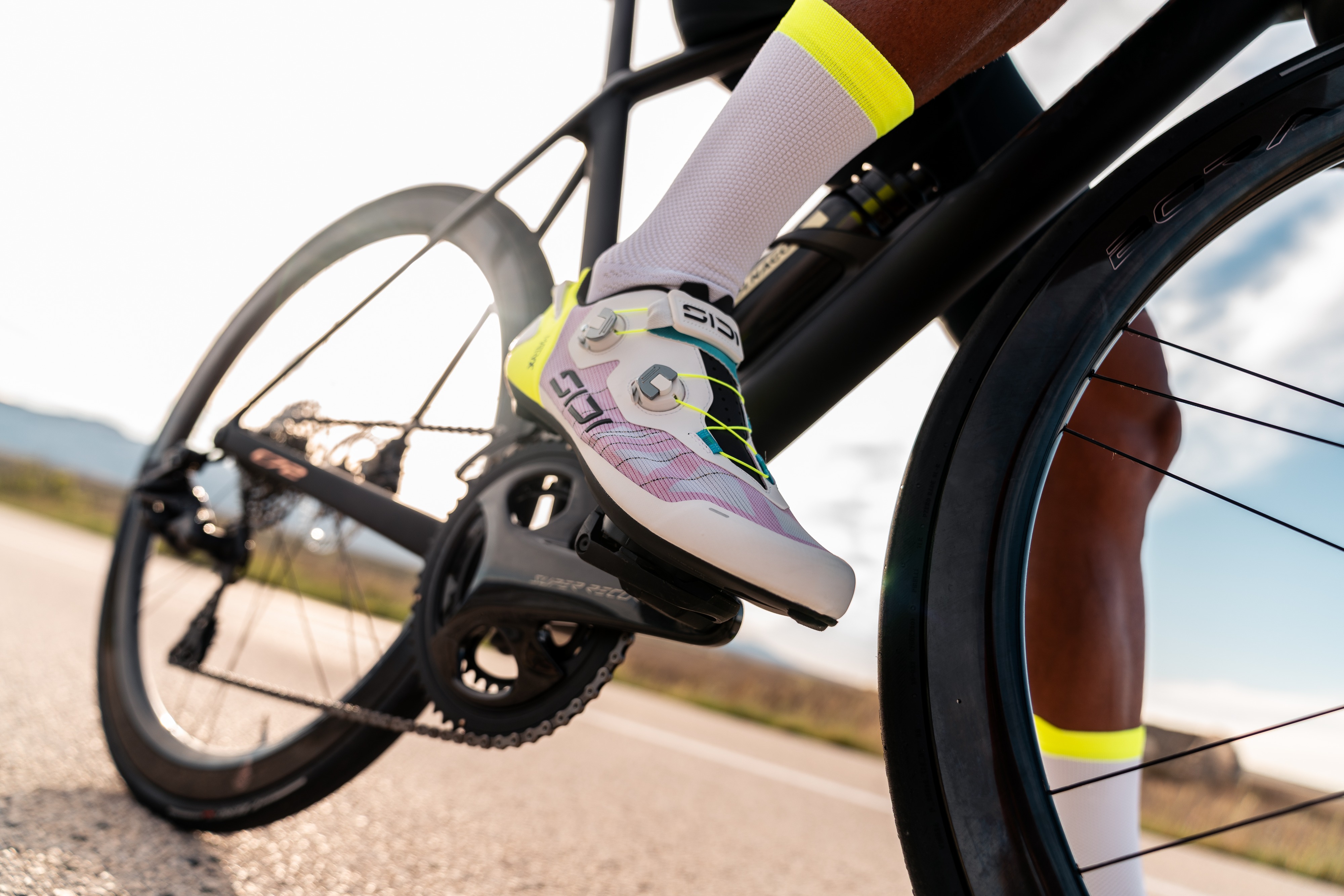
Switching gears entirely — literally — SIDI's road cycling shoes are built around a completely different priority: efficient power transfer with the least possible energy loss between your foot and the pedal. If you're the kind of rider tracking watts, chasing PRs on local climbs, or training seriously for events, the shoe you're pedaling in is not a place to cut corners.
Look for models with a full carbon-fiber sole, which maximizes stiffness and minimizes flex during hard efforts, paired with a ratcheting dial closure system that lets you make micro-adjustments to fit without stopping to fumble with straps or laces. A snug, low-volume fit through the midfoot is generally what serious road cyclists want, since it improves power transfer and reduces hot spots on long rides.
If you've read reviews mentioning that SIDI shoes run narrow, that's generally accurate for the standard fit — riders with wider feet should specifically look for the brand's wide or "Mega" fit options rather than assuming they'll stretch into a standard-width shoe over time.
- Prioritize a full carbon-fiber sole for maximum power transfer
- Look for a ratcheting dial closure for precise, on-the-fly fit adjustments
- A snug, low-volume fit is standard for performance road shoes
- Wider-footed riders should look for Mega-width versions specifically

If You're a Mountain Biker
Trail riding introduces a different set of demands than road cycling, and SIDI's MTB shoes are built accordingly. Unlike road shoes, which barely need to touch the ground, mountain bike shoes have to handle hike-a-bike sections, loose rock, mud, and roots — all while still delivering enough stiffness for efficient pedaling.
Look for a reinforced toe box to protect against rock strikes, an aggressive outsole tread pattern for traction when you're off the bike, and a closure system secure enough to stay locked in through rough, technical terrain without loosening mid-ride. Some riders also prioritize a slightly more flexible sole than a road shoe, since a small amount of give underfoot can actually improve traction and comfort during hike-a-bike sections.
If you ride both cross-country and more aggressive trail terrain, it's worth deciding which style you do more often before choosing between SIDI's lighter XC-oriented shoes versus its more rugged trail and enduro options, since the two are tuned for noticeably different riding styles.
- Prioritize a reinforced toe box for protection against rock strikes
- Look for an aggressive tread pattern for off-bike traction
- Choose a secure closure system built to handle rough terrain
- Match the shoe to your riding style — XC versus trail/enduro
The Sizing Mistake That Trips Up Almost Every First-Time Buyer
Regardless of which category you fall into, there's one mistake that shows up again and again among U.S. buyers ordering SIDI gear for the first time: assuming their usual U.S. shoe size translates directly. Because SIDI is an Italian brand built around European sizing and, historically, a narrower toe box shape, ordering based on a U.S. size alone can lead to a boot or shoe that's noticeably tighter than expected.
The fix is simple but easy to skip when you're excited to order: always check the specific size chart for the exact model you're buying, rather than relying on a size that worked for a different pair or a different brand entirely. If you have wider feet, actively look for "Mega" width versions where available instead of assuming a standard width will loosen up with wear — cycling shoes and motorcycle boots generally don't break in the way a casual sneaker does.
When in doubt between two sizes, most experienced SIDI owners recommend sizing up rather than down, particularly for motorcycle boots you'll be wearing with thicker socks on longer rides. A boot that's slightly roomier is a minor annoyance; a boot that's genuinely too tight can cause real discomfort and circulation issues over hours of riding.
- Don't assume your U.S. shoe size translates directly to SIDI sizing
- Always check the size chart for the specific model, not a general one
- Look for Mega-width options if you have wider feet
- When in doubt, size up rather than down, especially for boots

A Quick Decision Checklist Before You Buy
If you've read this far and you're still torn between two or three models, it helps to boil the decision down to a short set of questions rather than trying to compare every spec side by side. Ask yourself what your riding actually looks like on a typical week, not on your best or most ambitious day — that's usually the more honest guide to what you need.
Consider how many consecutive hours you're typically in the saddle, whether you regularly ride in wet conditions, how much walking you do while wearing the boot or shoe, and whether you've ever crashed or expect a higher-than-average risk of going down given your riding style. Each of those answers points fairly clearly toward a different section of the SIDI lineup covered above.
Finally, don't overlook the long-term cost picture. Because so many SIDI boots and shoes are built with replaceable components, a slightly higher upfront price can work out cheaper over several years than replacing a budget pair every season or two.
- Base your choice on typical riding, not your best-case scenario
- Factor in ride duration, weather exposure, and walking needs
- Consider crash risk and protection level honestly
- Weigh long-term cost, not just the upfront price tag
Final Thoughts
There's no single "best" SIDI boot or shoe — there's only the one that's best for how you actually ride. A commuter and a motocross racer have almost nothing in common in terms of what they need from a boot, and trying to buy the same pair would leave one of them badly under-protected and the other one uncomfortable all day.
Use the breakdown above to narrow things down to a category, double-check the size chart for your specific model, and you'll land on a pair that actually matches your riding instead of guessing based on looks or price alone.
- Match the boot or shoe to your actual riding style, not just your budget
- Always verify sizing on the specific model before ordering
- Replaceable components make higher-tier models a smarter long-term buy
- The right SIDI pair should disappear on your foot, not fight you all day
Found your category above? Browse the full SIDI lineup here and gear up with confidence.